Does pool pH increase over time?
For the most part, pool pH will rise over time, so there are not too many cases where a pool’s pH remains low, or continues to lower over time.
What to do if pH is high in salt water pool?
Use a pool test kit to check the pH, acid demand, and total alkalinity. Once you’ve determined that the pH level is too high, you should now work to restore the balance. There are two main products for lowering the pH. These are sodium bisulfate (also known as dry acid) and muriatic acid.
Does new pool plaster raise pH?
As the plaster cures it will continue to raise the pH level, it is important that you test the water frequently to maintain the proper water chemistry. Brush the pool twice a day for the first two weeks. All it takes is a little work and attention to maintain the life of your plaster finish.
Can high chlorine cause high pH?
High pool pH is caused by a wide variety of issues. Here are common causes of an alkaline pool: Algae can raise the pH. Adding strong liquid chlorine, calcium or lithium hypochlorite chlorine may raise it.
What should the pH level be in a salt water pool?
Check the stabilizer level. An unnaturally high pH level in your salt water pool could be a sign that your salt cell has been shortened due to running for an overly long period of time. Check the level of your cyanuric acid to be sure. The level should be between 80 and 100 ppm. 2. Alter your salt system’s run time.
What causes a high pH in a swimming pool?
It creates a byproduct called sodium hydroxide (NaOH), which has a high 13+ pH. Sodium Hydroxide raises the pH of the pool. The chlorine generator reaction looks like this: In our experience, salt pools almost always have a pH that drifts up.
What happens if you put too much acid in your pool?
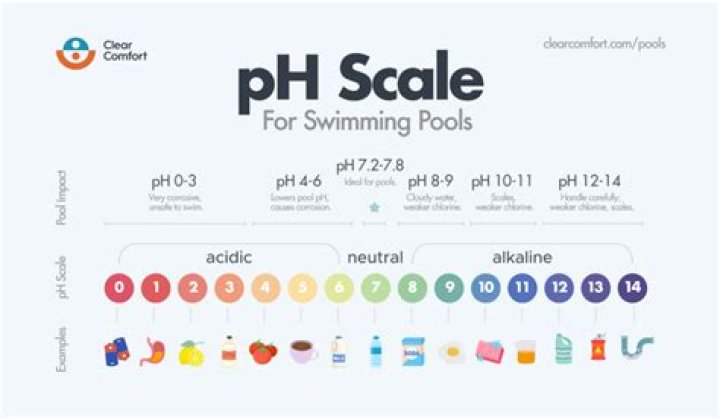
If your pH is too low, the water can become corrosive to your pool equipment. If your pH is too high, the chlorine becomes much less effective for sanitation. Pools with salt systems tend to have a higher pH level. Because of this, you will probably be adding a little more acid to your pool than most traditional chlorine pools.
How does the pH of the pool affect the effectiveness of chlorine?
The pH in a pool or spa impacts the sanitizer efficacy of chlorine tremendously. For example, at a pH of 7.2, chlorine is 65 percent effective; at 7.8, 32 percent effective; and at 8.0, 20 percent. As you can see, chlorine effectiveness decreases dramatically as the pH in water increases.
Check the stabilizer level. An unnaturally high pH level in your salt water pool could be a sign that your salt cell has been shortened due to running for an overly long period of time. Check the level of your cyanuric acid to be sure. The level should be between 80 and 100 ppm. 2. Alter your salt system’s run time.
Why does my swimming pool have a high pH?
The pool is still green this morning. When the TA is on the high side, the pH will tend to rise due to carbon dioxide outgassing. Remember that shocking is not a one-time event — it is a SUSTAINED high level of chlorine and you’ll need to add chlorine frequently at first as the chlorine will get consumed killing algae.
If your pH is too low, the water can become corrosive to your pool equipment. If your pH is too high, the chlorine becomes much less effective for sanitation. Pools with salt systems tend to have a higher pH level. Because of this, you will probably be adding a little more acid to your pool than most traditional chlorine pools.
How often should you test your salt water pool?
This study tells us two things: The first is that salt generators will cause the pH in a pool to rise quickly. The second is that once-a-week testing and adjustment is not enough to maintain proper pH levels. How many of your customers with saltwater pools are hand-dosing multiple times a week?
