How do you fix total chlorine?
How Do I Correct Bad Chlorine or pH Balance?
- Why Too Much Chlorine Is Dangerous.
- Tips for Lowering the Chlorine in Your Pool.
- Option 1: Stop Adding Chlorine.
- Option 2: Let In Some Sunlight.
- Option 3: Add Neutralizing Chemicals.
- Option 4: Replace Existing Water.
- Get in touch with a Swimming Pool Expert.
Why can’t I raise the chlorine level in my pool?
If you test your pool water and can’t get a chlorine level reading at all it may be due to a very high chlorine demand. Contamination, low pH or low chlorine stabiliser levels could cause this situation. The water might appear cloudy, the pool walls be slimy or the pool may look relatively OK.
Does shock increase free chlorine?
When you’re shocking a pool, the goal is to raise the free chlorine level of the pool water to roughly 10 times the combined chlorine level. Reaching this mark is the breakpoint chlorination. Shocking a pool should be done at dusk. The sun will burn off unstabilized chlorine.
Why don’t I have free chlorine in my pool?
Things that cause low free chlorine levels are excessive sunlight, high bather loads, and improper water chemistry. Not having enough chlorine in your swimming pool will also cause the little bit of chlorine that’s in there to be used up faster too.
How to raise the chlorine level in a swimming pool?
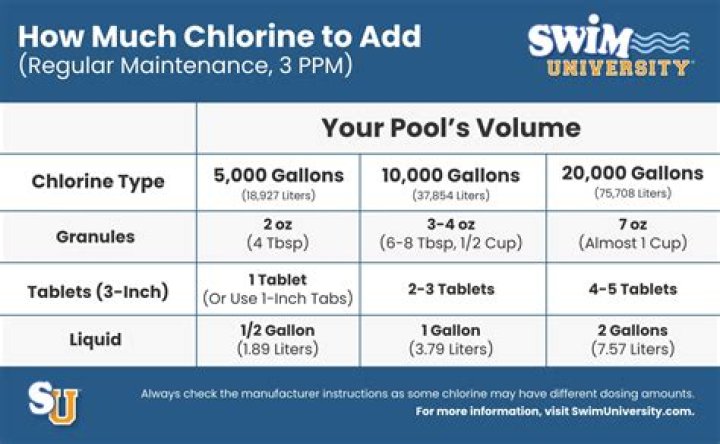
How to Raise the Chlorine Level in a Swimming Pool 1 Test the FAC concentration so you know how much you have to raise it. 2 Calculate the pool volume if you don’t know it already. 3 Read the instructions on the product you are using to determine how much you need to add… 4 Backwash the pool filter,…
How much chlorine do you need to shock a pool?
To shock the pool, you typically need to raise the chlorine level in the pool at or above 10 ppm. You need to follow the instructions on the shock container based on your pool size to achieve this. Leave the pool uncovered after shocking, as the pool water needs to be exposed to air to allow oxidation gasses to escape.
Can you add liquid bleach to a pool?
Stay with one variety of chlorine, as mixing products can make it difficult to maintain consistent chlorine levels in your pool. You can add regular retail liquid bleach, but there is no reliable way to determine how much chlorine will end up in your pool, as the shelf life reduces the chlorine effectiveness.
Why does my pool not have enough chlorine?
Not having enough chlorine in your swimming pool will also cause the little bit of chlorine that’s in there to be used up faster too. Even acid rain and other biomatter getting into your pool will cause free chlorine levels to drop. How to raise free chlorine in pool water?
How can I lower the chlorine level in my Pool?
Another method to decrease chlorine levels in your pool is to remove the pool cover. If you have one, open it up and let the sun shine down. Sunlight is known to lower chlorine levels in relatively short periods of time.
What is the ideal chlorine level for a pool?
Optimum chlorine levels for most water temperatures is between 1 and 3 parts per million (ppm). Ideally, the swimming pool should always be around 2 ppm, and the water needs to be tested regularly.
How do you increase free chlorine in a pool?
One way to raise the chlorine level is to use chemicals to free the chlorine from these compounds and turn it back into FAC. The other way is simply to add more chlorine in one of the five forms in which it is sold in stores. credit: GregoryButler. Chlorine degrades in sunlight, so it’s best to add it at night.
How to bring down chlorine in an indoor pool?
How to Lower Chlorine in a Pool Method 1 of 3: Basic Techniques. Understand “chlorine smell” and stinging eyes. Many people think that a chemical smell or stinging eyes are signs of chlorine. Method 2 of 3: Adding Chemicals to Lower Chlorine. Purchase a chlorine neutralizer from a pool supply store. Method 3 of 3: Using Ultraviolet Lamps. Understand UV disinfection.
