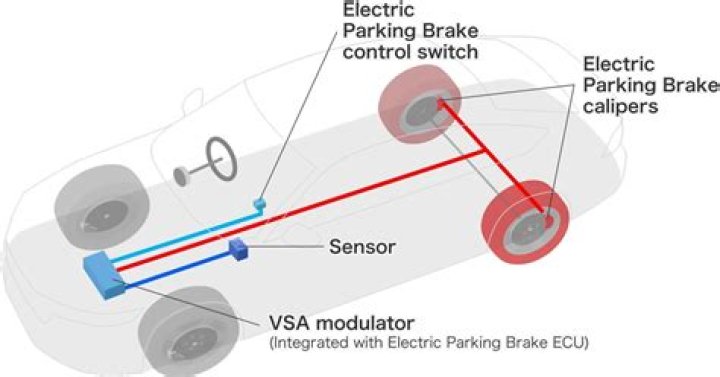
Is the parking brake on the front or rear?
It is located either between the front two seats or to the left of your gas and brake pedal. A parking brake controls the rear brakes and is a completely separate device from your vehicle’s regular hydraulic brakes.
What is the parking brake connected to?
The parking brake is connected to the rear brakes, which do not exert as much force in braking as the front brakes and will do little to stop a vehicle moving at high speeds. Most modern applications of the parking brake is to ensure that a parked vehicle stays in place, especially on hills and other declines.
Does the parking brake activate the front tires?
Whilst most vehicles have the parking brake applied to the rear wheels, some car models of Citroen, Alfasud, Saab and early Subarus apply the parking brake force to the front wheels.
Does the parking brake use the same line as the main brake?
Auxiliary brakes are more commonly called a parking brake, an emergency brake, or a handbrake, and are connected to calipers that grip onto the rear wheel rotors. These are not the same calipers that the normal brakes use because the emergency brake system is separate from the main brakes in case of brake failure.
What happens if you drive with your parking brake on?
When you drive with the parking brake even partially on for several miles, it’s possible to warp a drum or disc. Or if the brakes get really overheated, you can even cause the lining’s adhesive to fail, and have the linings crack or even separate from the pads or the brake shoes.
What parking brake has a deeper offset than normal?
The rotor has a deeper offset than normal, giving the appearance of a top hat. The offset portion allows room for a drum surface within the center of the rotor. Drum brake shoes are mechanically forced outward into contact with the inside of the brake drum, which locks the wheel.
Should you use e brake when parking?
You should use your emergency brake every time you park. It doesn’t matter if you’re on a hill or a flat parking lot, whether you drive an automatic or manual transmission, or whether the weather is pleasant or inclement. As the name suggests, you should also use your emergency brake in an emergency.
Which brake is used in heavy car parking?
Air brakes are mainly used in heavy vehicles like busses and trucks because hydraulic brakes fails to transmit high brake force through greater distance and also pneumatic brakes generates higher brake force than hydraulic brake which is the need of the heavy vehicle.
Should I use the parking brake on automatic transmission?
When to use emergency brakes You should use your emergency brake every time you park. It doesn’t matter if you’re on a hill or a flat parking lot, whether you drive an automatic or manual transmission, or whether the weather is pleasant or inclement.
What happens if you pull the electronic parking brake while driving?
But, since electronic parking break is controlled by a computer, it will not lock the rear wheels regardless of your enthusiasm. One of two things might happen – nothing or it will work as a very strong push on the brake pedal. No locking wheels due to ABS. For your own safety, of course.
Do water soaked brake shoes cause brake fade?
Tech A says that friction brakes can fade due to overheating of the brake lining. Tech B says that friction brakes can fade due to overheating of the brake fluid. Tech A says that kinetic energy is created during braking to stop the vehicle. Tech A says that water soaked brake shoes can be a cause of brake fade.
Where are the cables for the parking brake located?
A lever to engage and disengage the parking brake, found within the cabin of the vehicle Steel cables to connect to the main brakes of the vehicle located in the rear, often called a parking brake equalizer The cable system features a “Y” design that allows a set of cables to be connected to each rear brake.
Where is the parking brake adjustment screw located?
An adjustment screw may be located on the front cable where it connects to the equalizer, or where the cable attaches to the parking brake lever. The equalizer linkage can rust up, interfering with proper application and release. The hinge pivot can also break loose and render the parking brake useless.
How does a parking brake on a commercial vehicle work?
This is an added safety mechanism that is often seen on commercial vehicles. A recent development in parking brakes is the electric parking brake. It functions much the same way as the traditional parking brake, except that it engages at a push or pull of a button instead of using a mechanical lever.
Where is the parking brake equalizer cable located?
The equalizer linkage, in turn, is connected to a single cable that runs to the parking brake lever or pedal. An adjustment screw may be located on the front cable where it connects to the equalizer, or where the cable attaches to the parking brake lever. The equalizer linkage can rust up, interfering with proper application and release.
A lever to engage and disengage the parking brake, found within the cabin of the vehicle Steel cables to connect to the main brakes of the vehicle located in the rear, often called a parking brake equalizer The cable system features a “Y” design that allows a set of cables to be connected to each rear brake.
How does a parking brake work on a car?
Choose from lots of top quality brands, incl Whether you call it the emergency brake, parking brake or hand brake, they all work about the same way. You press a pedal or pull a lever, and a dedicated set of pads or shoes engage the rear brakes, locking them up for secure parking.
What happens when the parking brake is not engaged?
When the parking brake is not engaged on a regular basis, it begins to corrode. Shielded cables are especially vulnerable because water and road debris gets trapped in the outer shell. You won’t realize there is a problem until you need the brake, which is why regular inspection is important.
Why does my parking brake cable keep rusting?
Periodic use can break apart small rust spots or allow moisture to escape to some degree. When the parking brake isn’t used very much, the cable does not move through its insulation. If the parking brake is never used, rust can build up inside the insulation and lock the cable in place.
